
Retail Revenue Sharing: Free Up Capital with Consignment & Commission
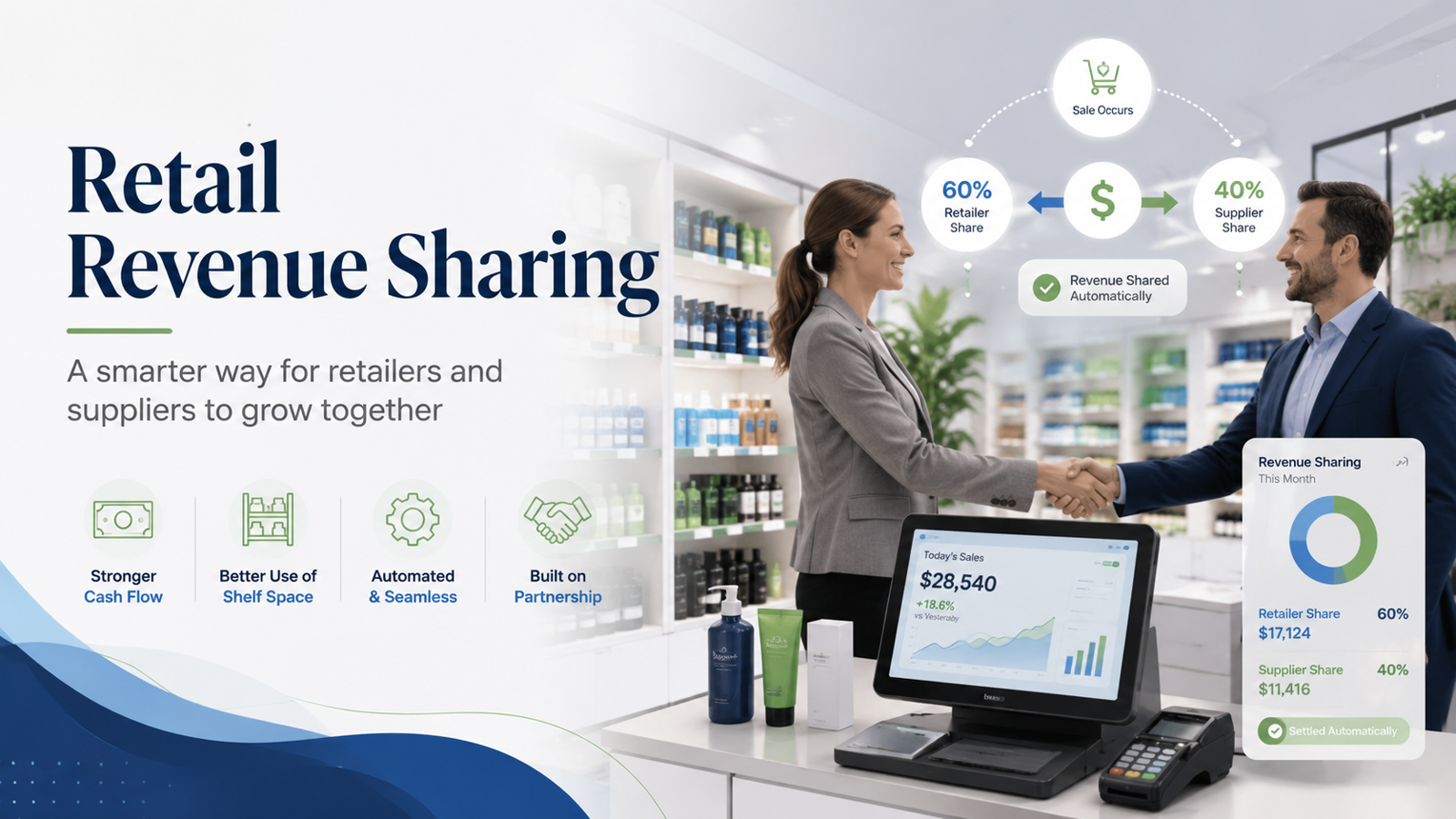
Retail runs on a quiet contradiction. Retailers need a wide, fresh range to pull customers in — but every product on the shelf is capital locked up before a single sale. Suppliers want that shelf space — but shipping goods on traditional invoices means chasing payment and carrying the risk if the product doesn't move. Someone always loses.
Retail revenue sharing breaks that trade-off. Instead of a store buying stock up front, the store and supplier agree to share the revenue of each sale — automatically, as items sell. Below is how the model actually works, the three variants you'll encounter, and how to tell if it fits your business.
What is revenue sharing in retail?
Retail revenue sharing is a commercial arrangement where a retailer sells a supplier's products and the sale value is split between them according to an agreed percentage — rather than the retailer purchasing the inventory outright. The supplier keeps ownership (and the risk) until the moment of sale; the retailer contributes the floor space, footfall, and checkout. When an item sells, both parties are paid their share.
The result: the retailer expands range with near-zero inventory capital, and the supplier gains distribution with far lower payment risk.
Consignment vs. commission vs. wholesale
These terms get used loosely. The practical differences:
- Wholesale (the old default): the retailer buys the goods, owns them, and carries all the risk. Cash goes out before it comes in.
- Consignment: the supplier retains ownership until the product sells. Unsold goods can be returned or moved. The retailer pays only for what actually sells.
- Commission: a percentage of each sale goes to each party. It can pair with consignment (pay-as-you-sell) or with a smart invoice that spreads payment over the sales period.
Most modern setups blend them — for example, seasonal goods on a longer-payment smart invoice and core NOOS ("never out of stock") lines on straight commission.
How it works with POS integration
The friction with commission and consignment has always been the admin: reconciling what sold, who's owed what, and when. That's the part automation solves. A platform like SplitGrid connects directly to the store's POS or e-commerce system, so the flow becomes:
- Agreement — retailer and supplier set the split terms.
- Integration — the POS/e-commerce system is connected (often in minutes).
- Automatic tracking — every sale is matched to the agreement in real time.
- Weekly reporting — both sides see exactly what sold.
- Automated payouts — each party's share is distributed on schedule.
No spreadsheets, no invoice-chasing, no month-end reconciliation marathon.
Who benefits — and how
- Retailers (see the trader view): expand range without buying inventory, protect cash flow, and test new brands with zero downside.
- Suppliers (see the supplier view): win more shelf space across more stores, get paid reliably as goods sell, and move slow inventory between locations instead of discounting it.
- Landlords: turnover-based rent lowers vacancy risk and creates more resilient tenancies.
Is revenue sharing right for your business?
It fits best when you want to grow range or distribution but can't — or don't want to — tie up more capital in stock, and when your sales run through a POS or e-commerce system that can be integrated. If you're weighing it up, our 2-minute profitability check maps your setup to the right model and next steps.